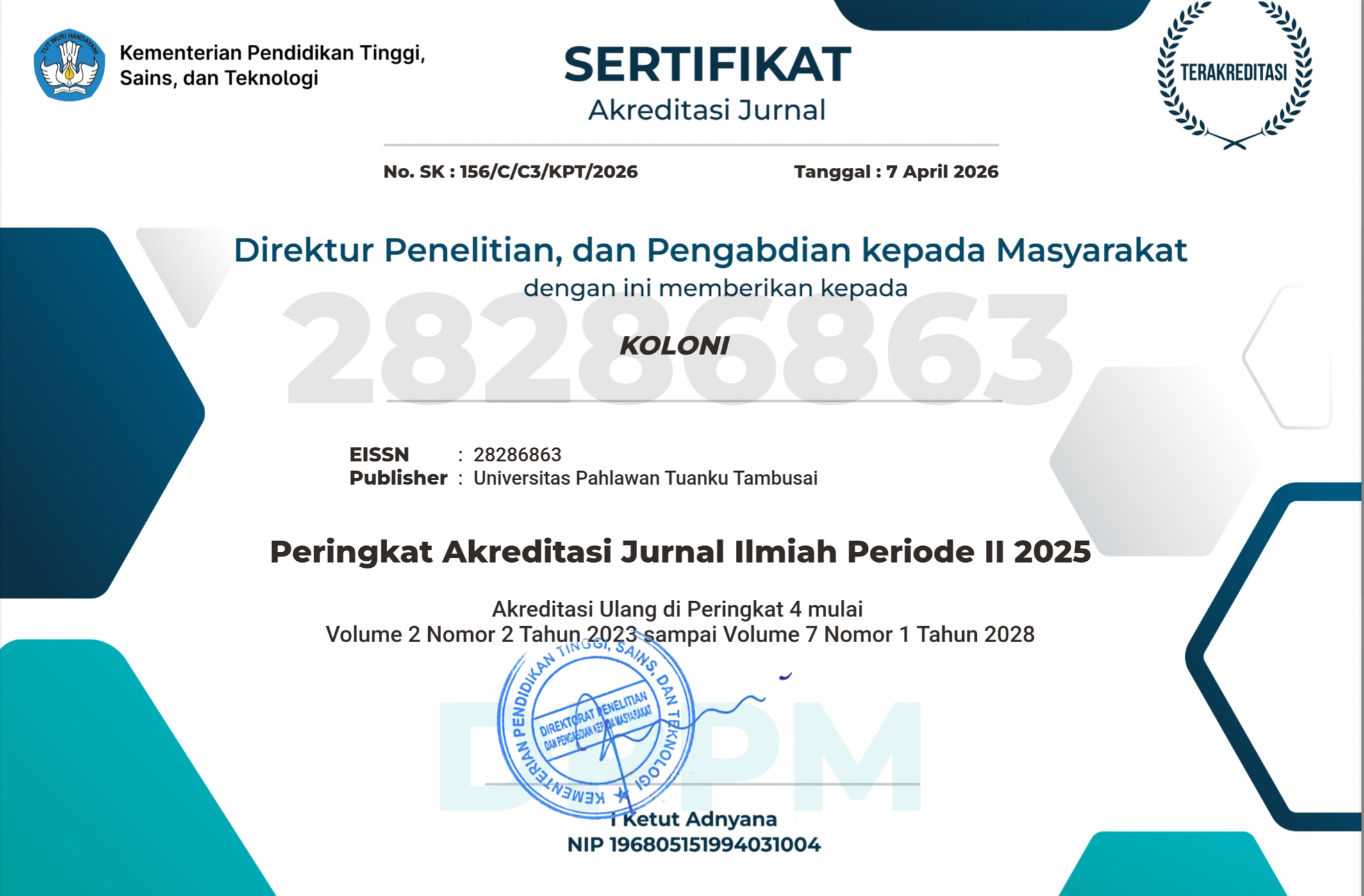
Manajemen Fisioterapi Pada Pasien Post Torakotomi E.C Fraktur Costae Dengan Keluhan Sesak Napas Dan Kekakuan Otot Dada: Sebuah Laporan Kasus
DOI:
https://doi.org/10.31004/koloni.v5i3.1461Keywords:
cardiopulmonary physiotherapy; rib fracture; post-thoracotomy; dyspnea; thoracic expansion exerciseAbstract
Rib fractures resulting from blunt chest trauma often lead to respiratory complications and long-term functional impairment when not properly managed (Pharaon, Marasco, & Mayberry, 2015; Seok et al., 2023). Thoracotomy performed to repair pleural injury after trauma can result in chronic pain, reduced chest wall expansion, and shoulder mobility limitation without prompt rehabilitation (Wildgaard, Ravn, & Kehlet, 2009). This case report aims to describe the physiotherapy management of a 57-year-old man presenting with mild dyspnea and chest muscle stiffness following post-traumatic thoracotomy. The patient underwent surgery on 8 December 2025 and presented to the Physiotherapy Outpatient Clinic of RSUD Bali Mandara on 28 July 2026, complaining of dyspnea during long-distance walking and stair climbing. Physiotherapy interventions included infrared, ultrasound, pursed-lip breathing, thoracic expansion exercise, and pectoralis stretching exercise over six sessions (28 July–3 August 2026). Outcomes were evaluated using the Visual Analogue Scale (VAS), midline chest expansion measurement, goniometry, manual muscle testing, the Borg scale, and the 2-Minute Step Test (2MST). Results showed a decrease in movement pain from 3/10 to 1/10 and pressure pain from 3/10 to 2/10, while dyspnea scores and shoulder muscle strength remained stable within normal limits. In conclusion, a combination of electrotherapy modalities and breathing–stretching exercises may help reduce pain in post-thoracotomy cases, although improvement in thoracic expansion and activity tolerance requires a longer treatment duration.References
Battle, C., Pelo, C., Hsu, J., et al. (2023). Expert consensus guidance on respiratory physiotherapy and rehabilitation of patients with rib fractures: An international, multidisciplinary e-Delphi study. Journal of Trauma and Acute Care Surgery, 94(4), 578–583. https://doi.org/10.1097/TA.0000000000003875
Cavalheri, V., Granger, C. L., Jenkins, S., et al. (2023). Rehabilitation pre- and post-thoracic surgery: Progress and future directions. Chronic Respiratory Disease.
Ceyhan, Y., & Tekinsoy Kartin, P. (2022). The effects of breathing exercises and inhaler training in patients with COPD: Study protocol for a randomized controlled trial. Trials, 23, 707.
Chuachan, S., Jitmana, R., Promsri, U., Thongdaeng, P., Kosura, N., & Chittithavorn, V. (2025). Impact of respiratory muscle-stretching exercise on chest expansion and shoulder mobility post-thoracotomy: A randomized controlled trial. Journal of Cardiothoracic Surgery, 20, 11. https://doi.org/10.1186/s13019-025-03760-9
Kendrick, K. R., Baxi, S. C., & Smith, R. M. (2000). Usefulness of the modified 0–10 Borg scale in assessing the degree of dyspnea in patients with COPD and asthma. Journal of Emergency Nursing, 26(3), 216–222.
Kumar, A., et al. (2022). The therapeutic effects of low-intensity pulsed ultrasound in soft tissue diseases: A review. Frontiers in Bioengineering and Biotechnology, 10, 1080430.
Mador, M. J., Rodis, A., & Magalang, U. J. (1995). Reproducibility of Borg scale measurements of dyspnea during exercise in patients with COPD. Chest, 107(6), 1590–1597.
Pharaon, K. S., Marasco, S., & Mayberry, J. (2015). Rib fractures, flail chest, and pulmonary contusion. Current Trauma Reports, 1, 237–242. https://doi.org/10.1007/s40719-015-0026-7
Rikli, R. E., & Jones, C. J. (1999). Development and validation of a functional fitness test for community-residing older adults. Journal of Aging and Physical Activity, 7(2), 129–161.
Seok, J., Yoon, S. Y., Lee, J. Y., Kim, S., Cho, H., & Kang, W. S. (2023). Novel nomogram for predicting pulmonary complications in patients with blunt chest trauma with rib fractures: A retrospective cohort study. Scientific Reports, 13, 9385. https://doi.org/10.1038/s41598-023-36679-z
Stucki, G. (2005). International Classification of Functioning, Disability, and Health (ICF): A promising framework and classification for rehabilitation medicine. American Journal of Physical Medicine & Rehabilitation, 84(10), 733–740. https://doi.org/10.1097/01.phm.0000179521.70639.83
Tsagkaris, C., Papazoglou, A. S., Eleftheriades, A., Tsakopoulos, S., Alexiou, A., Găman, M.-A., & Moysidis, D. V. (2022). Infrared radiation in the management of musculoskeletal conditions and chronic pain: A systematic review. European Journal of Investigation in Health, Psychology and Education, 12(3), 334–343. https://doi.org/10.3390/ejihpe12030024
Wildgaard, K., Ravn, J., & Kehlet, H. (2009). Chronic post-thoracotomy pain: A critical review of pathogenic mechanisms and strategies for prevention. European Journal of Cardio-Thoracic Surgery, 36(1), 170–180.
Wilson, R. C., & Jones, P. W. (1989). A comparison of the visual analogue scale and modified Borg scale for the measurement of dyspnoea during exercise. Clinical Science, 76(3), 277–282.
World Health Organization. (2001). International Classification of Functioning, Disability and Health (ICF). Geneva: WHO.
Downloads
Published
How to Cite
Issue
Section
License
Copyright (c) 2026 Kadek Ayu Cynthia Dewi, Made Bagus Aditya Putra Astika, Anak Agung Istri Meilani Trisna Dewi, I Gd Pratama

This work is licensed under a Creative Commons Attribution-ShareAlike 4.0 International License.